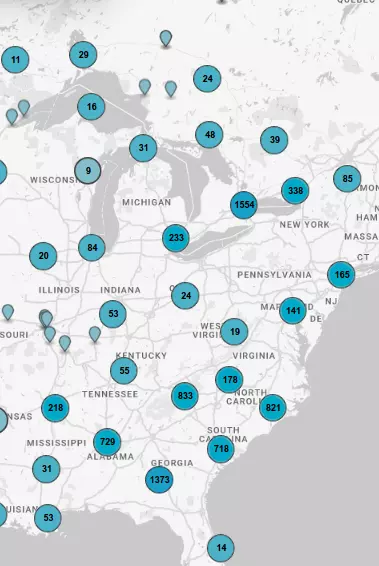
Parsons Site

You are now near one of Toronto's most studied archeological sites. Around 1450, a large ancestral Huron-Wendat village stood on the rise of land overlooking Black Creek. Almost three hectares in...
- toronto
- ontario
- alan brown
Playter Farmhouse

This house was erected in the mid-1870's by John Lea Playter, a great grandson of United Empire Loyalist, Captain George Playter, who with his sons, was granted lands on both sides of the...
- toronto
- ontario
- alan brown
Primrose Club Building (Faculty Club) 1920

Architects Benjamin Brown and Arthur W. McConnell designed this building for the Primrose Club, an elite Jewish organization that provided its members with a private social space....
- toronto
- ontario
- alan brown
Paul Oberman Walk 1957-2011

Paul Oberman was a heritage preservationist, real estate developer and visionary city-builder who passionately believed and demonstrated that heritage buildings could be restored through adaptive...
- toronto
- ontario
- alan brown
Potter's Field of Muddy York

The Trustees of the Toronto General Burying Grounds established "The Potter's Field" on this site in 1826 as the area's first non-sectarian cemetery. This group of concerned citizens raised the...
- toronto
- ontario
- alan brown
Palais Royale

This building stands at the eastern end of the former Sunnyside Amusement Park. It was opened in 1922 as both a dance hall and Walter Dean's boat factory. Remodelled in 1924 and 1928, it...
- toronto
- ontario
- alan brown
Philosopher's Walk Amphitheatre
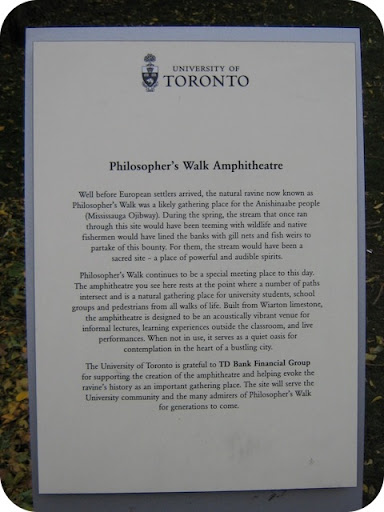
Well before European settlers arrived, the natural ravine now known as Philosopher's Walk was a likely gathering place for the Anishinaabe people (Mississauga Ojibway). During the spring,...
- toronto
- ontario
- alan brown
The Printers' Strike of 1872

The Nine-Hour Movement of 1872 was a broad labour effort to achieve a shorter work day through concerted strike action. The printers of the Toronto Typographical Union went on strike for...
- toronto
- ontario
- alan brown
Prospect Cemetery

There was an increasing need for non-sectarian burying grounds in the 19th century as the City was expanding westward. Toronto General Burying Grounds purchased a long and narrow plot of 42...
- toronto
- ontario
- alan brown
Precambrian Erratic

This Precambrian erratic was slowly transported to the Leaside area by a glacier more than 10,000 years ago. It was uncovered about one block north of the library when new gas lines were...
- toronto
- ontario
- alan brown
Paul Kane 1810-1871

Paul Kane was born in Ireland and immigrated with his family to the town of York in 1818. He began his career as a sign painter, turning later to portraits. In 1841 he journeyed to Europe...
- toronto
- ontario
- alan brown
Poulton Block 1885

This prominent building was constructed for William B. Poulton, a painter and a Mason, primarily for use by the Masonic Orient Lodge. The block was designed by Kennedy, Gaviller &...
- toronto
- ontario
- alan brown
Princes' Gates

These monumental gates were erected in 1927 to mark the 60th anniversary of Canadian Confederation. Designed in the Beaux-Arts style by the Toronto firm of Chapman and Oxley, the gates - including...
- toronto
- ontario
- alan brown
Pendarves - Cumberland House

Renowned Toronto architectural firm Cumberland & Storm designed this building as the family home of senior partner Frederic W. Cumberland. Completed in 1860 and named Pendarves, the...
- toronto
- ontario
- alan brown
Acetylene Gas Generating Station

Submitted by @jqmcd.
- virginia
- herndon
Paul Kane Park

Paul Kane purchased this property and built a stucco cottage in 1853. Enlarged in the late 1850's, and again in 1873 with the addition of buff brick and a porch, the house was owned by the Kane...
- toronto
- ontario
- alan brown
The Pontifical Institute of Mediaeval Studies

In the 1920s, Professor Étienne Gilson, a noted French mediaevalist, and Henry Carr, C.S.B., of St. Michael's College, conceived a unique plan for a graduate centre for mediaeval studies. When...
- toronto
- ontario
- alan brown
The Palace Pier

The vision of a grand lakefront amusement pier was conceived in the 1920s as a rival for the neighbouring Sunnyside Pavilion. The pier was designed by Craig & Madill with various structures in a...
- toronto
- ontario
- alan brown
Primrose Club
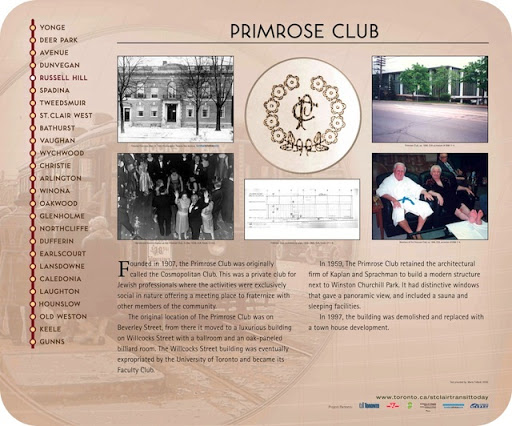
Founded in 1907, the Primrose Club was originally called the Cosmopolitan Club. This was a private club for Jewish professionals where the activities were exclusively social in nature offering...
- toronto
- ontario
- alan brown
Principal Patrick Trench Johnson

He was born in Assam, India in 1926, and schooled in England before receiving his commission with the Gurkha Rifles in 1944. After service overseas, he attended Oxford where he received his...
- toronto
- ontario
- alan brown