
St. Anne's Anglican Church

Built in the Byzantine style, St. Anne's was designed by the noted Toronto architect Ford Howland to serve a large and vigorous parish. It was constructed in 1907-08, replacing an earlier building...
- toronto
- ontario
- alan brown
St. Lawrence Hall

St. Lawrence Hall was an important venue for many African Canadian activities in support of abolition and the welfare of refugee slaves in Toronto. It provided an important platform for major...
- toronto
- ontario
- alan brown
Scott-Westney House circa 1861

This house was originally on Sheppard Avenue East. First sold to Stephen Westney, the house was purchased by George Scott in 1887. The Scott family owned it until the 1950s. The vernacular Ontario...
- toronto
- ontario
- alan brown
St. Michael's College

In 1852 this college was established as a Roman Catholic boys' school in the palace of the Right Reverend Armand, Comte de Charbonnel, Bishop of Toronto and a vigorous opponent of the...
- toronto
- ontario
- alan brown
Scarborough's "Golden Mile"

Surrounded by farmland until the 1940s, this stretch of Eglinton Avenue, from Pharmacy Avenue to Birchmount Road, became famous in the 1950s as Scarborough's "Golden Mile of Industry" - a hub...
- toronto
- ontario
- alan brown
See House 1885-86

The official residence the Bishop of the Anglican Diocese (or "See") of Toronto from 1885 until 1935, this house became the administrative centre of Royal St. George's College in 1964. Designed...
- toronto
- ontario
- alan brown
St. Margaret's Church

Scarborough's first Anglican Church was built in 1833 on a .8 ha lot given for a church yard and burying ground by Simon E. Washburn, clerk of the home district and a church warden of St....
- toronto
- ontario
- alan brown
Sir John A. Macdonald 1815-1891

Canada's first Prime Minister was born in Glasgow, Scotland, and immigrated with his family to Kingston, Upper Canada, in 1820. A successful lawyer, he was elected to the provincial legislature in...
- toronto
- ontario
- alan brown
The Second Invasion of York 1813

On the morning of July 13, 1813, a U.S. invasion fleet appeared off York (Toronto) after having withdrawn from a planned attack on British positions at Burlington Heights. That afternoon 300...
- toronto
- ontario
- alan brown
Stanley Barracks

The British army established a military post here in 1840-41 to replace aging Fort York. Known as the New Fort, it consisted of seven limestone buildings around a parade square, and a number...
- toronto
- ontario
- alan brown
St. Lawrence Hall

Designed by William Thomas, in the Renaissance tradition, this hall, built by the city in 1850, was for many years Toronto's chief social and cultural centre. With its handsome Corinthian facade...
- toronto
- ontario
- alan brown
"Sunrise" Park

While living in the nearby Bradgate Arms, young Ernest Seitz (1892-1978) completed his now famous song "The World Is Waiting For The Sunrise". In 1919, words were added by Gene Lockhart of...
- toronto
- ontario
- alan brown
Sir Ernest MacMillan (1893-1973)

Knighted in 1935 for services to music in Canada, Ernest MacMillan was a familiar figure to adults and school children alike. A composer and organist, he was for many years conductor of...
- toronto
- ontario
- alan brown
Spruce Court Apartments 1913 (with later additions)

Spruce Court is one of the earliest examples of publicly supported rental housing in Canada. It was the first project constructed for the Toronto Housing Company, an organization that...
- toronto
- ontario
- alan brown
St. Peter's Anglican Church
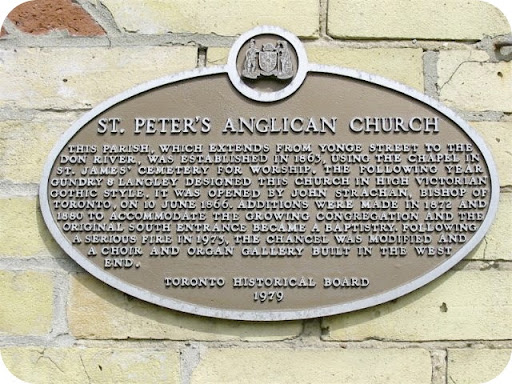
This parish, which extends from Yonge Street to the Don River, was established in 1863, using the Chapel in St. James' Cemetery for worship. The following year Gundry & Langley designed...
- toronto
- ontario
- alan brown
St. James' Cathedral

York's first church was built here in 1803-07 with the aid of public subscriptions and a government grant. That frame building was enlarged in 1818-19 and replaced by a larger one in 1831. The...
- toronto
- ontario
- alan brown
Sir Gordon Drummond 1771-1854

Born at Quebec, Gordon Drummond had a distinguished military career in various parts of the Empire before becoming Administrator of Upper Canada and commander of the British forces in the province...
- toronto
- ontario
- alan brown
Saint Luke's United Church Centennial 1887-1987

This church was known as Sherbourne Street Methodist when it opened for worship 5 June 1887. Designed by architects Langley and Burke, it replaced a smaller house of worship built here in 1871....
- toronto
- ontario
- alan brown
Site of the Christie Street Veterans' Hospital

On this site stood the Christie Street Veterans' Hospital, originally the National Cash Register Company Factory. In 1919 the factory was converted to the Toronto Military Orthopaedic...
- toronto
- ontario
- alan brown
St. John the Baptist, Norway

This church, designed by C.J. Gibson, was built in 1893 and enlarged by C.D. Lennox in 1915. Distinctive features are a high-peaked, hammer- beamed roof and stained glass from the original church...
- toronto
- ontario
- alan brown