Saint Thomas's Anglican Church

Saint Thomas's was founded in 1874 as the Anglican Parish Church for Seaton Village. The congregation relocated twice before moving to a new, larger building on this site in 1893. A fine example...
- toronto
- ontario
- alan brown
Sir Oliver Mowat 1820-1903

Born in Kingston, where he was trained as a lawyer, Oliver Mowat served as a Toronto alderman before his election to the legislature of the united Canadas as a Reformer in 1857. He joined the...
- toronto
- ontario
- alan brown
Sunnyside Amusement Park
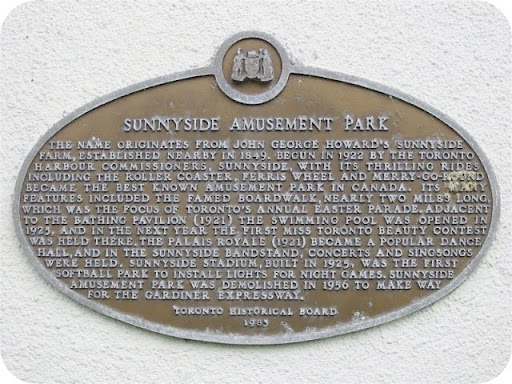
The name originates from John George Howard's Sunnyside Farm, established nearby in 1849. Begun in 1922 by the Toronto Harbour Commissioners, Sunnyside, with its thrilling rides including...
- toronto
- ontario
- alan brown
Spadina and the Austins

The present Spadina estate at the crest of this hill, originally comprising 52 hectares of land, was occupied by the Austin family for more than 100 years. James Austin (1813-1897) built...
- toronto
- ontario
- alan brown
Saint Michael's Cemetery, 1855

Toronto's first Roman Catholic Cemetery was beside St. Paul's Church in east downtown Toronto which was established as a Parish in 1822. This cemetery was rapidly filled as a result of the many...
- toronto
- ontario
- alan brown
St. Jude's Church

Erected in 1848 by the Rev. Wm. Stewart Darling and the Anglican families of the Wexford area of Scarborough, the site of the church and the cemetery was originally a private burial plot of the...
- toronto
- ontario
- alan brown
Straightening the Don, 1890
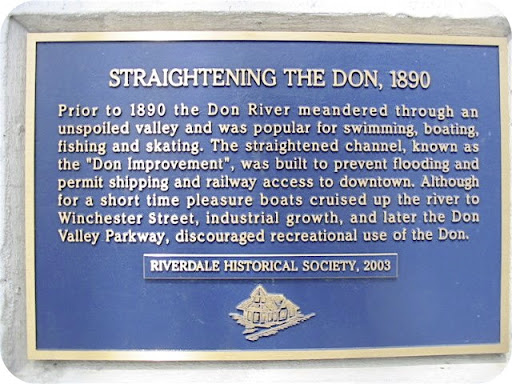
Prior to 1890 the Don River meandered through an unspoiled valley and was popular for swimming, boating, fishing and skating.The straightened channel, known as the "Don Improvement", was built to...
- toronto
- ontario
- alan brown
Streetcar Suburb

On ribbons of steel and a streak of chained lightning, Toronto's transportation destiny arrived with its first electric streetcars in 1892. "Riding the witch's broom," it was called. And just as...
- toronto
- ontario
- alan brown
Scarborough Bluffs

The layers of sand and clay exposed in these cliffs display a remarkable geological record of the last stages of the Great Ice Age. Unique in North America, they have attracted...
- toronto
- ontario
- alan brown
The Souster Steps

The Souster Steps are named for one of Toronto's most beloved poets. Raymond Souster (1921-2012) lived for 17 years on Mayfield Avenue, nigh Willard Gardens Parkette - or "Lollipop Park."...
- toronto
- ontario
- alan brown
Royal Alexandra Theatre 1907

A vital part of Toronto's cultural history, the Royal Alexandra is one of North America's oldest, continuously operating theatres. An early work of Toronto architect John M. Lyle, the theatre...
- toronto
- ontario
- alan brown
Robert Baldwin 1804-1858

Born in Toronto, Baldwin devoted his political life to a single cause. As a member of the assembly (1829-30 and 1841-51), as Executive Councillor (1841), as Solicitor General (1840-1), and as...
- toronto
- ontario
- alan brown
Roads over the Humber River

The array of traffic lanes at the mouth of the Humber River began with an Aboriginal footpath, formed along the lakeshore thousands of years ago. By 1798, a wider wagon path had been cleared...
- toronto
- ontario
- alan brown
Riverdale Branch, Toronto Public Library 1910

Designed in Georgian Revival style by city architect Robert McCallum, Riverdale Branch was one of ten public libraries built with Carnegie grants in what is now Toronto. The wedge-shaped building...
- toronto
- ontario
- alan brown
The Riverdale Hospital

The Riverdale Isolation Hospital dates from 1875 when a House of Refuge was established for the care of patients with infectious diseases such as whooping cough, smallpox and diphtheria....
- toronto
- ontario
- alan brown
Rosa and Spencer Clark

Erected by colleagues and friends of Rosa and Spencer Clark as a tribute to their life work in conservation, the arts and other facets of community service.The Guild of All Arts, co- founded by...
- toronto
- ontario
- alan brown
The Right Honourable Lester Bowles Pearson, 1897-1972

Born in the Newtonbrook Methodist parsonage which stood nearby, Pearson was educated at Toronto and Oxford Universities. He served overseas from 1915 to 1918 and, in 1928, joined the Department...
- toronto
- ontario
- alan brown
The Resting Place of Pioneers

In this area of the cemetery lie buried many of the inhabitants of the early town of "Muddy York".They were originally buried in "The Potter's Field", a plot of 2.4 ha in Yorkville at what is now...
- toronto
- ontario
- alan brown
The Robertson Building

The Robertson Building at 215 Spadina was originally home to the James Robertson Company, manufacturers and distributors of plumbing fittings and fixtures. The building was constructed in 1911 to...
- toronto
- ontario
- alan brown
The Royal Canadian Naval Volunteer Reserve

The adjacent plaque was the first created by the Toronto Historical Board, and was installed in 1969 on an earlier building on the site. It marks the first place in Toronto where citizens...
- toronto
- ontario
- alan brown