Fort St. Joseph

The most westerly military post in Upper Canada. Built in 1796-99, and garrisoned from 1796 to 1812 by parties from the Queen's Rangers, Royal Canadian Volunteers, 41st and 49th Regiments and 10th...
- toronto
- ontario
- alan brown
The Founding of Arkona

By 1836 the earliest settlers on the site of Arkona, notably Henry Utter, Nial Eastman, and John Smith, had located in the vicinity. Within three years Utter, the first to arrive, had constructed...
- toronto
- ontario
- alan brown
The Founding of New Hamburg
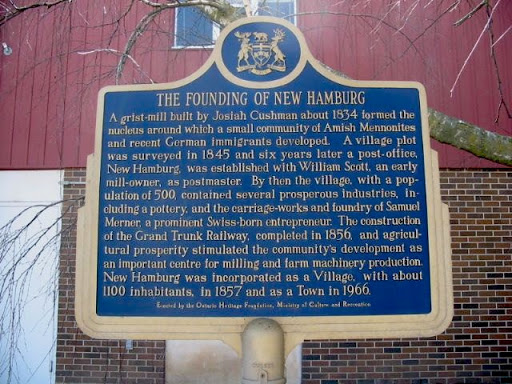
A grist-mill built by Josiah Cushman about 1834 formed the nucleus around which a small community of Amish Mennonites and recent German immigrants developed. A village plot was surveyed in 1845...
- toronto
- ontario
- alan brown
The Founding of Dundas

In 1793 Lieutenant-Governor Simcoe authorized a townplot in this vicinity at the then eastern terminus of Dundas Street. Its original name, "Coote's Paradise", was derived from that of...
- toronto
- ontario
- alan brown
The Founding of Chesley

A small settlement, "Sconeville", developed here following the erection of mills on the Saugeen River by Adam Elliot in 1858-59. A post-office, named after Solomon Chesley, a former...
- toronto
- ontario
- alan brown
The Founding of Queenston

Following the loss, after the American Revolution, of the Niagara River's east bank, a new portage around Niagara Falls was established in the 1780s' with Queenston its northern terminus....
- toronto
- ontario
- alan brown
The Founding of Petrolia

Following the discovery of oil at Oil Springs in 1857 prospectors extended their search to the entire township of Enniskillen. At the site of Petrolia, which contained two small settlements with...
- toronto
- ontario
- alan brown
The First Meeting of the Executive Council of Upper Canada

Because of the Loyalist influx into the western part of Quebec after the American Revolution, the province was divided into Upper and Lower Canada (now Ontario and Quebec). The Constitutional...
- toronto
- ontario
- alan brown
Founding of Port Robinson

Port Robinson, the southern terminus of the original Welland Canal, opened in 1829, was named for John Beverley Robinson, chief justice of Upper Canada. The village grew rapidly when hundreds...
- toronto
- ontario
- alan brown
The Founding of Seaforth

Anticipating the construction of the Buffalo, Brantford and Goderich Railroad through this region, Christopher and George Sparling acquired, during 1850-53, most of the present site of Seaforth....
- toronto
- ontario
- alan brown
The Founding of Teeswater

By 1855 the first permanent settlers on the site of Teeswater, the families of Matthew Hadwen and Peter Brown, had located here on the Tesswater River, In that year Brown erected a saw-mill...
- toronto
- ontario
- alan brown
The Founding of London

In 1793 here on the river Thames, Lieutenant- Governor John Graves Simcoe selected a site for the capitol of Upper Canada. York, however, became the seat of government and the townsite of...
- toronto
- ontario
- alan brown
Founding of Lyndhurst

Development of this community began after the construction of the province's first successful iron smelter and a sawmill in 1801. On the west bank of the river a grist-mill was built in 1827 and a...
- toronto
- ontario
- alan brown
Frederick House

A Hudson's Bay Company post named after a son of George III, Frederick House was established in 1785 to prevent Canadian fur traders in the Abitibi region from intercepting the passage of furs to...
- toronto
- ontario
- alan brown
The Frontenac Road
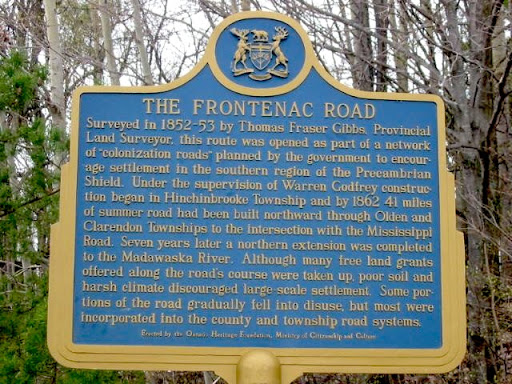
Surveyed in 1852-53 by Thomas Fraser Gibbs, Provincial Land Surveyor, this route was opened as part of a network of "colonization roads" planned by the government to encourage settlement in...
- toronto
- ontario
- alan brown
Froome and Field Talfourd

Froome (1807-1902) and Field (1815-74) Talfourd emigrated from England in 1832 and in the following year took up adjoining lots here in Moore Township. Froome had previously served in H.M.S....
- toronto
- ontario
- alan brown
The Founder of Elora

Captain William Gilkison (1777-1833) was born in Ayrshire, Scotland, and emigrated to North America in 1796. He served with the British forces in the War of 1812 as an assistant...
- toronto
- ontario
- alan brown
First Steam Train 1853

On May 16, 1853, the Ontario Simcoe and Huron Union Railroad Company operated the first steam train in Canada West from Toronto to Machell's Corners (Aurora). The train, consisting of...
- toronto
- ontario
- alan brown
Former Port Perry Town Hall
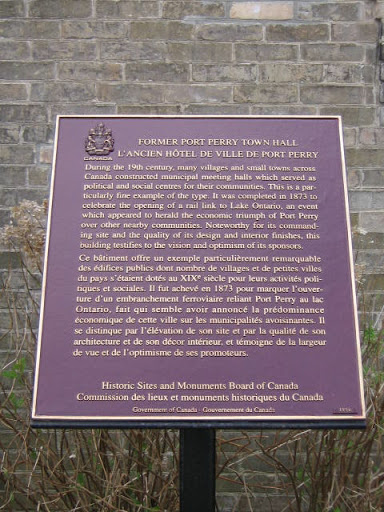
During the 19th century, many villages and small towns across Canada constructed municipal meeting halls which served as political and social centres for their communities. This is a particularly...
- toronto
- ontario
- alan brown
Founding of Merrickville

In 1793 William Merrick (1760-1844), a Loyalist from Massachusetts, acquired from Roger Stevens a sawmill at the "Great Falls" on the Rideau River. Here he built new mills which formed the...
- toronto
- ontario
- alan brown