Goldwin Smith 1823-1910

Born and educated in England, Goldwin Smith taught history at Oxford and Cornell before moving to Toronto in 1871. He married Harriette Boulton in 1875, widow of William Henry Boulton of...
- toronto
- ontario
- alan brown
George Leslie 1804-1893

Leslieville is named for gardener and businessman George Leslie who established the Toronto Nurseries in the area in 1845. His greenhouses and extensive fields produced everything from flowers to...
- toronto
- ontario
- alan brown
Garrison Common and the Battle of York

Garrison Common is part of Fort York National Historic Site comprising 17.4 hectares (43 acres) of land. On April 27, 1813, it was part of a larger battlefield after some 2,500 American soldiers,...
- toronto
- ontario
- alan brown
George Brown
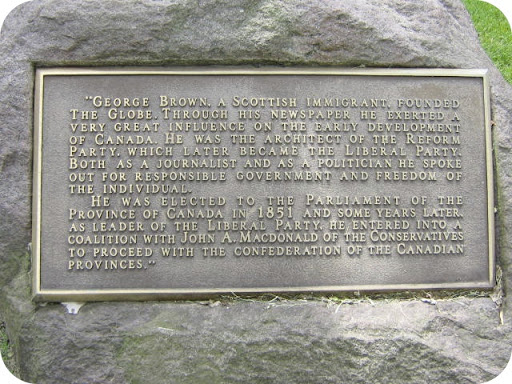
George Brown, a Scottish immigrant, founded The Globe. Through his newspaper he exerted a very great influence on the early development of Canada. He was the architect of the Reform Party, which...
- toronto
- ontario
- alan brown
The Great Toronto Fire

On an unusually cold April night, Fire Alarm Box 12 at the corner of Bay and King streets was pulled to signal the discovery of a fire at 58-60 Wellington Street West. Two days later the fire had...
- toronto
- ontario
- alan brown
Gibraltar Point

Because of its large and easily-defended harbour Lieutenant-Governor Simcoe decided to make Toronto the naval and military centre of Upper Canada. This site, guarding the harbour, was...
- toronto
- ontario
- alan brown
Grace Bagnato 1891-1950

The Canada of today has been created by thousands of immigrants from every corner of the world. Some of these became leaders in their communities and co-creators of the national life. Grace...
- toronto
- ontario
- alan brown
The Great Fire of 1849
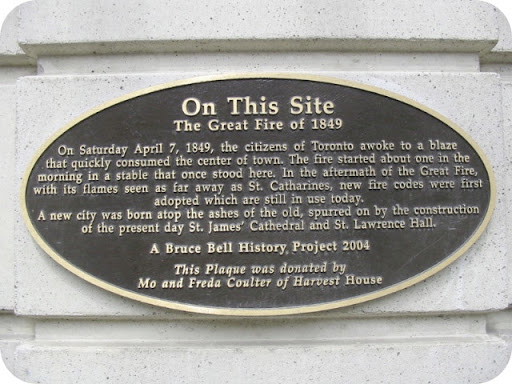
On Saturday April 7, 1849, the citizens of Toronto awoke to a blaze that quickly consumed the centre of town. The fire started about one in the morning in a stable that once stood here. In the...
- toronto
- ontario
- alan brown
Finch
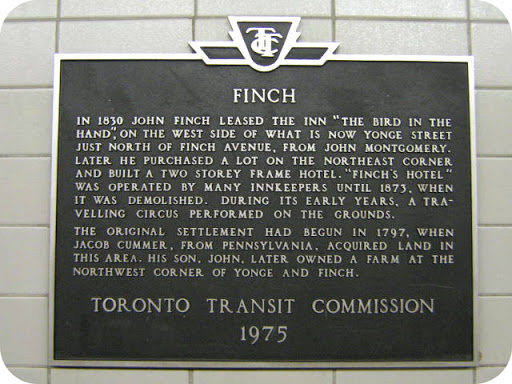
In 1830 John Finch leased the inn "The Bird in the Hand", on the west side of what is now Yonge Street just north of Finch Avenue, from John Montgomery. Later he purchased a lot on the northeast...
- toronto
- ontario
- alan brown
Fort Rouillé

The last French post built in present-day Southern Ontario, Fort Rouillé, more commonly known as Fort Toronto, was erected on this site in 1750-51. It was established by order of the Marquis de...
- toronto
- ontario
- alan brown
Frontier College

When established in 1899, Frontier College was the only national, non-denominational organization providing education to workers in remote parts of Canada. It sent idealistic youth to...
- toronto
- ontario
- alan brown
Frederic W. Cumberland 1820-1881

An outstanding Canadian architect, civil engineer and railway manager, Cumberland was born in England and practised there before immigrating to Toronto in 1847. He quickly gained...
- toronto
- ontario
- alan brown
Fort Rouillé

The concrete walkways in this area delineate the walls of Fort Rouillé, a French trading post located on this site from 1750 to 1759. The reconstructed ground plan of Fort Rouillé is based on...
- toronto
- ontario
- alan brown
Frederick Hubbard House 1909
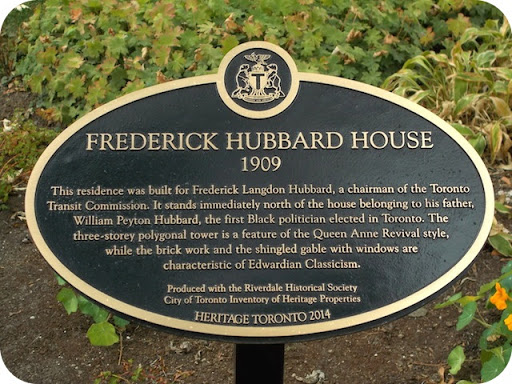
This residence was built for Frederick Langdon Hubbard, a chairman of the Toronto Transit Commission. It stands immediately north of the house belonging to his father, William Peyton Hubbard, the...
- toronto
- ontario
- alan brown
F.H. Torrington and the Toronto College of Music

Frederick Herbert Torrington (1837-1917), already a successful conductor and performer in Montreal and Boston, arrived in Toronto in 1873 to accept the position of organist and choirmaster...
- toronto
- ontario
- alan brown
Flight Lieutenant David Ernest Hornell, V.C., 1910-1944

Born in Toronto and educated in Mimico, Hornell enlisted with the Royal Canadian Air Force on January 8, 1941. He was commissioned Pilot Officer late that year. On June 24, 1944, while...
- toronto
- ontario
- alan brown
First Grey Cup Game

At Rosedale Field on December 4, 1909, the University of Toronto varsity team won First Grey Cup Game by defeating the Parkdale Canoe Club 26-6. Almost 4,000 spectators watched the Ontario Rugby...
- toronto
- ontario
- alan brown
Francis Collins

Francis Collins, Canada's first professional parliamentary debates reporter, was born CA. 1800 in Newry, County Down, Ireland. He had been a publisher before his arrival in York (Toronto) where,...
- toronto
- ontario
- alan brown
Financial District

The Financial District, centred at King and Bay Streets, is the financial heart of Canada, home to the corporate headquarters of the country's major banks and most prominent firms. With...
- toronto
- ontario
- alan brown
First Women's College Hospital

In 1911 the Women's College Hospital & Dispensary opened in a six-room house near here at 18 Seaton Street. At a time when most hospitals excluded women doctors from their staffs, it provided...
- toronto
- ontario
- alan brown