The Battle of Ezra Church - Plaque 5 - The Confederate Attack (con't)

Dense woods screened the extent of the Union line until revealed by storms of musketry which swept Brown´s ranks, in front and on the right where Williams´ fire enfiladed Johnston´s exposed...
- lat34
The Battle of Ezra Church - Plaque 4 - The Confederate Attack

On July 27th, Lieut. Gen. Stephen D. Lee assumed command of Hood´s former corps. Both he and Stewart directed to hold their respective corps "in readiness" and to report at Hood´s headquarters....
- lat34
The Battle of Ezra Church - Plaque 3 - The Union Dispositions
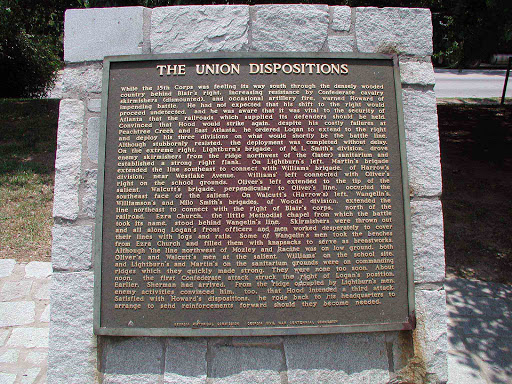
While the 15th Corps was feeling its way south through the densely wooded county behind Blair´s right, increasing resistance by Confederate cavalry skirmishers (dismounted), and...
- lat34
The Battle of Ezra Church - Plaque 2 - The Preliminary Operations

The city was encircled by 12 miles of fortification which Sherman later deemed "unassailable". Johnston was confident that he could hold Atlanta "forever", but he did not intend to become...
- lat34
The Battle of Ezra Church - Plaque 1

The Battle of Ezra Church July 28, 1864 The Battle of Ezra Church was the third of three desperate Confederate attacks on the forces of Maj. Gen. Wm. T. Sherman, which were closing in on Atlanta....
- lat34
The Evacuation of Atlanta

On July 30, 1864, General Hood, retaining Stewart´s corps in Atlanta, sent Hardee and Lee to Jonesboro to dispossess the enemy whose seizure of the railway at this point was ominous of...
- lat34
The Battle of Atlanta

Sherman´s grand objective in this campaign was the capture of Atlanta. The strategic importance of the Georgia capital as a military stronghold and depot of supplies was recognized by the...
- lat34
Transfer of Command

Under orders from President Davis, on July 17, 1864, General Joseph E. Johnston, the masterful tactician and soldier, relinquished command of the Army of Tennessee. To succeed him, General John...
- lat34
The Siege of Atlanta

Following these sanguinary Battle of July 22, 1864, enemy entrenched himself to the east and south of Atlanta. Then began the long and fearful siege which, lasting for six weeks, was veritably a...
- lat34
Hewlett Lodge

Hewlett Lodge The park’s headquarters and visitor center formerly served as a family summer retreat for Samuel D Hewlett, Sr., a prominent Atlanta attorney. Its rustic Adirondacks style –...
- lat34
Slave Square
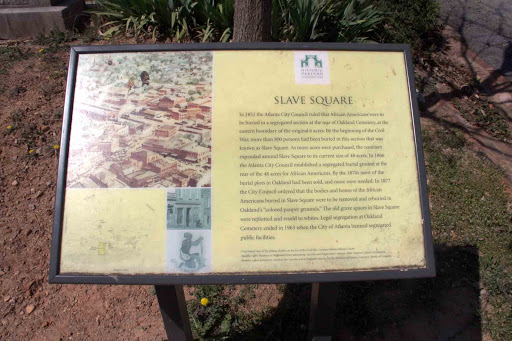
Slave Square In 1852 the Atlanta City Council ruled that African-Americans were to be buried in a segregated section at the rear of Oakland Cemetery, at the eastern boundary of the original 6...
- lat34
Yates and Milton Drug Store

On this site stood yet eight’s in Milton drugstore, the first African-American business of its kind in Atlanta. It was here that the Atlanta student movement was planned on February 4, 1960. Clark...
- lat34
An Appeal to Human Rights
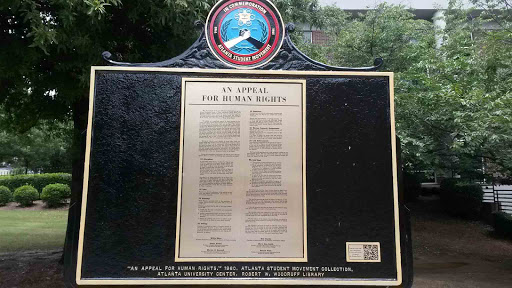
side 1 An Appeal For Human Rights small text – not transcribed The text is available at AN APPEAL FOR HUMAN RIGHTS side 2 An Appeal For Human Rights March 9, 1960 In March 1960, students of the...
- lat34
The Atlanta Student Movement

The Atlanta Student Movement 1960-1965 side 1 In early February 1960, Morehouse College students Lonnie King, Julian Bond, Joseph Pierce and other students met here at the site of the former...
- lat34
First Baptist Church of Alpharetta· c. 1905

In 1903, a group of women who met weekly for prayer and Bible study began collecting offerings. From those collections, the women purchased a sixty by one hundred foot lot and began construction...
- lat34
Mansell House • c. 1910

The Mansell House was built by Robert Mansell of South Carolina for his wife, Maude Dorris. It is a Queen Anne-style clapboard farm house built from pine trees located on the site. It has heart...
- lat34
Alpharetta Business District
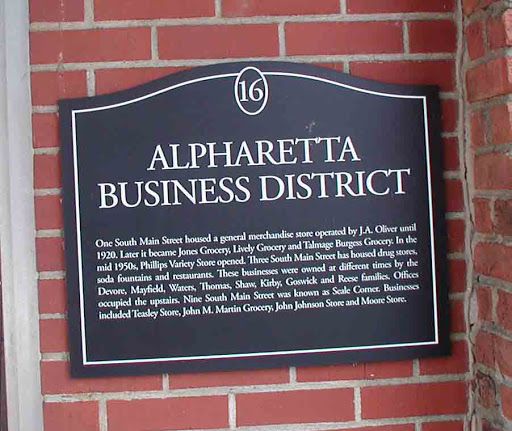
One South Main Street housed a general merchandise store operated by J.A. Oliver until 1920. Later it became Jones Grocery, Lively Grocery and Talmage Burgess Grocery. In the mid 1950s,...
- lat34
Alpharetta Business District
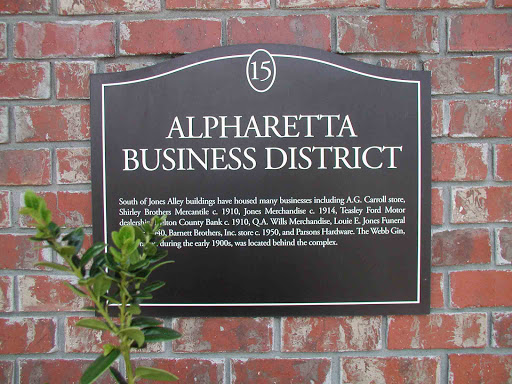
South of Jones Alley buildings have housed many businesses including A.G. Carroll store, Shirley Brothers Mercantile c. 1910, Jones Merchandise c. 1914, Teasley Ford Motor dealership, Milton...
- lat34
Alpharetta Business District

Alpharetta was formed in 1858 and soon after, a thriving business district was developed. Many of the businesses had two entrances, with one facing the Milton County Courthouse on Norcross...
- lat34
Skelton-Teasley House·c. 1856

The brick home was built for the family of Dr. Oliver P. Skelton, physician, postmaster and Ordinary of Milton County. His son-in-law John I. Teasley, a cotton planter, subsequently occupied it....
- lat34