
Cotton States International Exposition of 1895

Cotton States International Exposition of 1895 Was held for 100 days from Sept. 18 to Dec 31 1895 in Piedmont Park. This event was held at a time when the regions population was only 75.000...
- lat34
Booker T. Washington 1856-1915
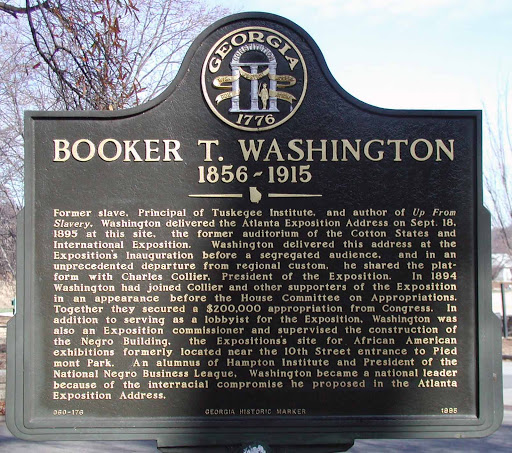
Former slave, Principle of Tuskegee Institute and author of Up From Slavery, Washington delivered the Atlanta Exposition Address on September 18, 1895 at this site, the former auditorium of...
- lat34
The Winecoff Fire

This is the site of the worst hotel fire in U. S. history. In the predawn hours of December 7, 1946 the Winecoff Hotel fire killed 119 people. The 15 - story building still stands adjacent to...
- lat34
Spelman College Women Who Serve

Spelman College was founded in 1881: The National Alumnae Association of Spelman College (NAASC) was Organizes by Clara Howard in May 1892. Miss Howard, a member of the first graduating...
- lat34
Thrasherville: Where Atlanta Began
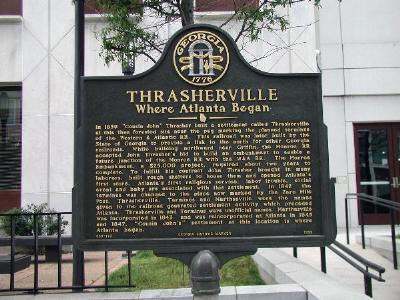
In 1839 "Cousin John" Thrasher built a settlement called Thrasherville at this then forested site near the peg marking the planned terminus of the Western & Atlantic RR. This railroad was...
- lat34
Fort McPherson

Named for Maj. Gen. James Birdseye McPherson, U. S. Vol. the Union Commander of the Army of Tennessee, during the Battle of Atlanta, this area was used as a state militia drill ground as early as...
- lat34
Georgia Railroad Depot

This is one of the oldest buildings in downtown Atlanta. It was completed on April 22, 1869, and served as the main freight depot for the Georgia Railroad. Corput and Bass, architects,...
- lat34
Howard's March to Jonesboro
![Aug. 1864. Howard´s Army of the Tenn. [US] having abandoned siege operations on the W. side of Atlanta, moved S. in a flanking march to cut the West Point R.R. at & below Shadnor Ch. On the 30th,...](http://lh3.googleusercontent.com/IokJtVRcqTo_eMizVL4U4wlT9nrUkrW-VzoICpiD3Ha_-7mMIon6QRNxW-ejuWAfX-kEvZi4Xisf7KLxpoTwXfnHJasR)
Aug. 1864. Howard´s Army of the Tenn. [US] having abandoned siege operations on the W. side of Atlanta, moved S. in a flanking march to cut the West Point R.R. at & below Shadnor Ch. On the 30th,...
- lat34
Howard's Corps at Nancy's Creek

July 18, 1864. The 4th A.C. marching from Crossroads Church to Buckhead, encountered a spirited opposition by Confederate cavalry & artillery S. of Mt. Paren Rd. On reaching the creek Newton´s...
- lat34
Shadnor Baptist Church

Organized in 1840 as the New Hope Baptist Church; named changed to Shadnor, 1853. The original log structure that stood a short distance north of present one, was a prominent landmark during...
- lat34
Site: Old Red Oak P.O.-1864

1864 - Siege operations on the Atlanta front having failed, the Federal Army moved against the 2 R. R. South of it. Howard´s Army of the Tennessee, Thomas´ Army of the Cumberland and Schofield´s...
- lat34
Mt. Gilead M.E. Church Organized 1824

In 1864, the building at this location was a prominent landmark in the final phases of Federal military operations against Atlanta. Three Federal army corps marched this way enroute to Red Oak...
- lat34
Dry Pond

An old Campbell County crossroad cited in James P. Snell´s Diary as "a one-horse settlement with no pond, but two or three houses and blacksmith shop´‘~~ a landmark in movement of Howard´s Army of...
- lat34
Site: Utoy Post Office On Old Sandtown Rd.

Est. March l836; discontinued July 7, 1866; a stop on the Decatur, Marthasville (Atlanta) White Hall & Sandtown stagecoach route in intervening years; also a landmark in the movement of Federal...
- lat34
Enroute to Jonesboro

Aug 26, 1864. The Federal Army of the Tenn., (15th, 16th and 17th corps) enroute to Fairburn and Jonesboro, camped on and near, the Wilson plantation. Gen. John A. Logan (15th A.C.)...
- lat34
The Siege Lifted

On Aug. 26th, 1864, after 35 days of futile siege operations, the Federals withdrew from their lines North and West of Atlanta, and a wide flanking march, moved against the two railroads...
- lat34
Confederate Intrenchments: 1864

This line of earthworks in Adams Park is one of the few remaining sections of the exterior portion of Atlanta´s defenses designed 5 a barrier to Federal attempts to cut the two railroads...
- lat34
The Embattled Ridge
![August 6, 1864. The ridge just south (densely wooded at the time) was fortified and held by General W.B. Bate´s division, Hardee´s A.C. [Confederate]. It extended west from the Atlanta to East...](http://lh3.googleusercontent.com/Fb-13O96ILnGey_xK_FNCnJUSI9s6imI9-9Nad4mNtHvf71Qwm8EkN_uTU4OiPMOwbE3k_8cdCpVXZVMVkkoIgLHOTo)
August 6, 1864. The ridge just south (densely wooded at the time) was fortified and held by General W.B. Bate´s division, Hardee´s A.C. [Confederate]. It extended west from the Atlanta to East...
- lat34
Howard's March to Buckhead

July 18, 1864. Howard´s 4th A.C. left Crossroads Ch 4:30 A.M., Newton´s div leading, followed by Stanley´s and Wood´s. Just below Mt. Paren rd. Newton´s column was assailed by Williams´...
- lat34
Battle of Utoy Creek

Federal siege operations not only involved the encircling line of Atlanta´s defenses, but threatened the two railroads South West of the city. Pursuant thereto, Federal forces after the battle of...
- lat34