

St. Joseph's College School

Originally called "St. Joseph's Academy for Young Ladies," the private school was founded by the Sisters of St. Joseph and was located on Power Street. In 1863, the Academy was incorporated in...
- toronto
- ontario
- alan brown
St. George's On-The- Hill

In 1844, William Gamble, a miller on the Humber River and the first Reeve of Etobicoke, donated this site on the shoreline of prehistoric Lake Iroquois to the local Church of England congregation....
- toronto
- ontario
- alan brown
Sir Oliver Mowat 1820-1903

Born in Kingston, Mowat studied law under John A. Macdonald. After moving to Toronto in 1840, he was elected a Liberal Member of the Legislature of the Province of Canada in 1857 and served...
- toronto
- ontario
- alan brown
St. Christopher House
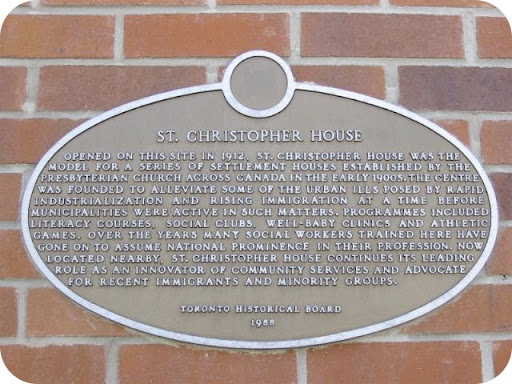
Opened on this site in 1912, St. Christopher House was the model for a series of Settlement Houses established by the Presbyterian Church across Canada in the early 1900s. The Centre was...
- toronto
- ontario
- alan brown
Sir Frederick Banting 1891-1941

Soldier, surgeon, and scientist, Banting in 1920 became convinced of the existence of a substance now known as Insulin. A laboratory provided by Dr. J.J.R. Macleod of the University of...
- toronto
- ontario
- alan brown
St. Lawrence Lofts

Georgian Corporation's renovation of 77, 81 and 85 Front Street East is a proud moment in the company's history. The residences known as the St. Lawrence Lofts consist of three...
- toronto
- ontario
- alan brown
Scadding Cabin

This log cabin, Toronto's oldest known surviving house, was constructed for John Scadding in 1794 during the first years of British settlement. Scadding was a government clerk and close friend of...
- toronto
- ontario
- alan brown
St. Matthew's Anglican Church 1890

Designed by Toronto architects Strickland and Symons, this charming example of Gothic Revival church architecture was constructed for an Anglican congregation founded in 1874. Growing quickly...
- toronto
- ontario
- alan brown
The St. George's Society of Toronto

The St. George's Society of Toronto, the city's oldest charity, was founded on St. George's Day, April 23, in 1834, at a meeting in the British Coffee House at King and York Streets. Named...
- toronto
- ontario
- alan brown
Sunnylea School

Designed by John Burnet Parkin, a local architect, this school with each classroom featuring project areas with sinks, large windows and slide-along curtains and exit doors to the outside, set...
- toronto
- ontario
- alan brown
Sunnybrook

These beautiful grounds, donated to the City of Toronto as a memorial park in honour of the late Joseph Kilgour, were, with the gracious consent and approval of the heirs to the Kilgour...
- toronto
- ontario
- alan brown
St. Joseph's, Leslieville, 1878

From the 1830's priests from downtown Toronto began to visit Leslieville, an area of market gardens and brickyards, to administer the sacraments to Catholics living in the east end of the city. In...
- toronto
- ontario
- alan brown
St. Michael's Hospital

First established in 1892 by the Sisters of St. Joseph, the Hospital is dedicated to the care and cure of the sick within and beyond the bounds of the City of Toronto.The surrounding masonry...
- toronto
- ontario
- alan brown
St. Andrew's Church

St. Andrew's was begun in 1874 to serve a Church of Scotland congregation organized in 1830. An outstanding example of Romanesque Revival architecture, this massive church was designed by William...
- toronto
- ontario
- alan brown
The Soldiers' Tower

The Soldiers' Tower is the University of Toronto's war memorial. A few months after the Armistice ended the First World War on 11 November 1918, the University of Toronto Alumni Association...
- toronto
- ontario
- alan brown
St. Andrew's Church

In 1817 the Rev. William Jenkins, a native of Kirriemuir, Scotland, a missionary to the Oneida Indians of New York, came to Canada in response to the plea of inhabitants of Scarborough,...
- toronto
- ontario
- alan brown
Standard Woollen Mills Building

This former industrial building was constructed in phases over two decades as Standard Woollen Mills expanded its operations. The earliest portion, constructed in 1882 and distinguished by its...
- toronto
- ontario
- alan brown
The Silverthorns

In 1700, Oliver Silverthorn left Yorkshire, England for New Jersey, then went to Niagara before settling in Etobicoke. He bought 200 ha on both sides of the Etobicoke River and ran a mill. His son...
- toronto
- ontario
- alan brown
St. Anne's Church

St. Anne's vibrant wall paintings make this church a place of national historic significance. They were executed in 1923 by ten Toronto artists, including J.E.H. MacDonald, F. Varley and...
- toronto
- ontario
- alan brown
Scarboro' Centennial Memorial Library

Scarborough's first public library, the Scarborough subscription library, was organized at a meeting at St. Andrew's Church on April 7th, 1834, with forty-six members paying a fee of...
- toronto
- ontario
- alan brown