
Public Grounds of the Parliament Buildings

In 1873 the Department of Public Works contracted with New York landscape architect Calvert Vaux to design a plan for the public grounds of Parliament Hill. Superseding a design by the English...
- toronto
- ontario
- alan brown
Pain Court

Settlement of this region began in the 1780s when English and French-speaking squatters from the Detroit area moved on to the Indian lands along the lower Thames River. By the 1820s in the...
- toronto
- ontario
- alan brown
Penetanguishene

The Attignawantan ("Bear Nation") of the Huron confederacy occupied the Penetanguishene peninsula prior to their dispersal in 1649 by the Iroquois. In 1793 Lieutenant-Governor Simcoe...
- toronto
- ontario
- alan brown
The Perth Road

This road was surveyed in 1852 to encourage settlement of the isolated townships lying between Kingston and Perth. It was begun and completed as far as Loughborough Lake in 1854 by the Kingston...
- toronto
- ontario
- alan brown
Point Mississauga Lighthouse

The first lighthouse on the Great Lakes was built of stone at Point Mississauga in 1804 by John Symington, under orders from Lieutenant-Governor Peter Hunter. Demolished in 1814 to make room...
- toronto
- ontario
- alan brown
Port Arthur

On Thunder Bay just north of Fort William, engineer Simon Dawson established the eastern terminus of the Canadian government's proposed land and water route connecting Lake Superior and the Red...
- toronto
- ontario
- alan brown
Port Burwell Lighthouse 1840

The Port Burwell lighthouse was constructed in 1840. It was part of a national network of light stations equipped with beacon lights to warn or guide ships at sea. The Port Burwell light was used...
- toronto
- ontario
- alan brown
The Parliament Buildings

In 1859 the province of Canada began to erect its Parliament buildings. The architectural competition was won by Fuller & Jones for the legislative building and by Stent & Laver for the east and...
- toronto
- ontario
- alan brown
Perth Military Settlement 1816

The present townships of Bathurst, Beckwith and Drummond were settled under the jurisdiction of the Quarter Master General's Department. Scottish emigrants, quartered in barracks at...
- toronto
- ontario
- alan brown
Peterborough Petroglyphs

Situated on an outcrop of white marble on the Canadian Shield, the Peterborough Petroglyphs site is one of the largest know concentrations of prehistoric rock carvings in Canada. Several hundred...
- toronto
- ontario
- alan brown
The Portage Road

This road follows the general route of the Indian portage from Lake Simcoe to Balsam Lake. The portage was first mapped by the Honourable John Collins, Deputy Surveyor General of Canada, when he...
- toronto
- ontario
- alan brown
Parkwood

A rare surviving example of the grand estates of the inter-war years, Parkwood consists of a richly decorated house set in 5 ha of grounds. The house, originally constructed in 1916-1917 to the...
- toronto
- ontario
- alan brown
Port Stanley

Kettle Creek was called by the Iroquois the "Kanagio", by the Ojibwas the "Akiksibi", by the French the "Riviére Tonti". Among early visitors were: Louis Jolliet, September, 1669; Dollier...
- toronto
- ontario
- alan brown
Porcupine Mining Area

From the 1880s onwards, as railways opened up northern Ontario, prospecting activity in this region intensified. The Porcupine gold rush began in 1909 following three significant...
- toronto
- ontario
- alan brown
The Precambrian Shield

The surrounding rock formation is among the oldest of the Earth's crust. Formed between one and two billion years ago, it is part of the Precambrian Shield, which occupies two-thirds of the...
- toronto
- ontario
- alan brown
Puce River Black Community

While the first Blacks arrived in the Puce River area during the 1830s, the community owed its existence largely to the Refugee Home Society. This abolitionist organization led by Henry and Mary...
- toronto
- ontario
- alan brown
The Port Arthur, Duluth and Western Railway Company
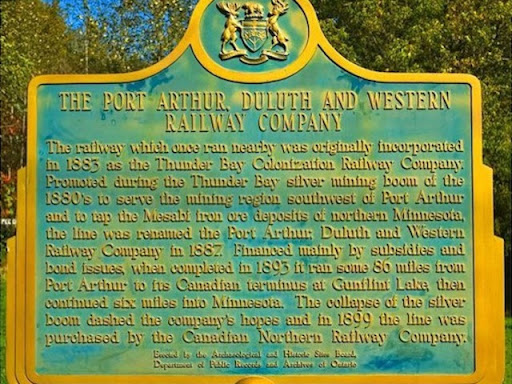
The railway which once ran nearby was originally incorporated in 1883 as the Thunder Bay Colonization Railway Company. Promoted during the Thunder Bay silver mining boom of the 1880's to serve the...
- toronto
- ontario
- alan brown
The P.L. Robertson Manufacturing Company

The first firm in the world to produce socket-head screws, the P.L. Robertson Manufacturing Company was formed in Hamilton in 1907 and relocated here the following year. It was established by...
- toronto
- ontario
- alan brown
Pro Patria 1812-1814

In memory of the officers and seamen of the Royal Navy and Provincial Marine, and of the officers and soldiers of the Royal Marines, Royal Newfoundland, King's (8th) and 100th Regiments, who...
- toronto
- ontario
- alan brown
The Peterborough Lift Lock
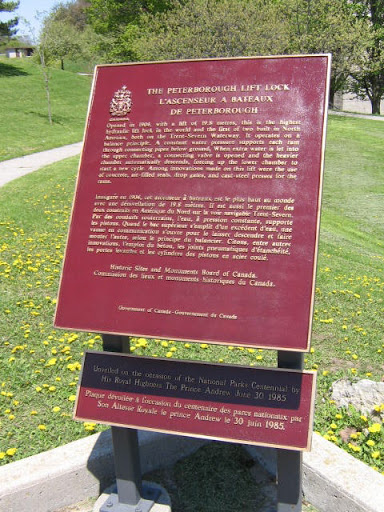
Opened in 1904, with a lift of 19.8 meters, this is the highest hydraulic lift lock in the world and the first of two built in North America, both on the Trent-Severn Waterway. It operates on...
- toronto
- ontario
- alan brown