The Eternal Flame

As the Cherokees began their journey along the trail, some were able to carry the embers of the fire of their last counsel in Red Clay, Tennessee; the last council ground of the Cherokee Nation...
- lat34
The Trail of Tears
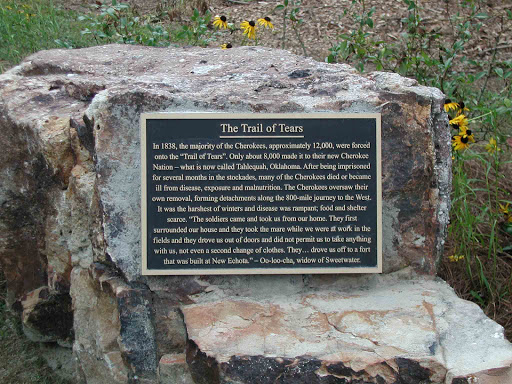
In 1838, the majority of the Cherokees, approximately 12,000, were forced onto the “Trail of tears”. Only about 8,000 made it to the new Cherokee Nation - what is now called Tehlequah, Oklahoma....
- lat34
The Removal of 1838

General Winfield Scott put the Cherokee removal into action in 1838. The Cherokee remained in their homes despite continuous warnings and directives to gather at the forts. “Cherokee!...
- lat34
To Honor Those Who Came Before US

This monument is a memorial to the Cherokees who were driven from their land and their homes against their will in 1838. Thousands died on the Nunna-da-ul-tsun-yi, commonly translated as...
- lat34
Founders Cemetery

This cemetery, the first burying ground of the village from 1840 to 1860. Among the distinguished dead who rest here are Roswell´s founder, Roswell King; Major James Stephens Bulloch, grandfather...
- lat34
The Georgia Land Lottery of 1832

Principal Chief John Ross traveled to Washington, D.C. to deliver a petition to the U.S. Congress signed by nearly every member of the Cherokee Nation. The land belonged to the Cherokees,...
- lat34
Eyewitness to Horror
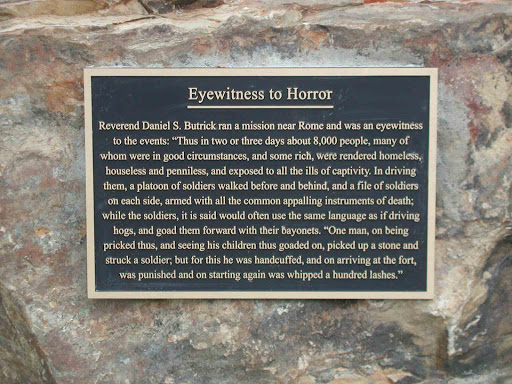
Reverend Daniel S. Butrick ran a mission near Rome and was eyewitness to the events: “thus in two or three days about 8,000 people, many of whom were in good circumstances, and some rich,...
- lat34
The Cherokee Nation

The Cherokee Nation “You asked us to throw off the hunter and warrior state: We did so - you ask us to form a republican government, We did so - adopting your own as a model. You asked us...
- lat34
Shotgun Houses / 472 - 488 Auburn Avenue

These duplexes are typical of the houses where Atlanta's blue-collar laborers lived in the early 1900s. The Empire Textile Co. built them for its white mill workers, but they moved out after...
- lat34
The Birthplace

For his first 12 years Martin Luther King, Jr., lived in the comfortable middle-class home across from you. Two cultural values distinguished the King household: a strong sense of family and...
- lat34
The Home

Young Martin Luther King. Jr.'s, childhood here was entirely normal. He did his chores and received his allowance. Neighbors often saw him bouncing a ball off the side of the house or riding his...
- lat34
Burial Ground of Congregation Ahavath

The section of the cemetery encompassing the area behind this marker, bounded by the lane to the east, the sidewalk to the west, and the wall to the south, was established in 1892 as the...
- lat34
Freedom Park

Freedom Park celebrates the lives and work of two renowned Georgians and Nobel Peace Prize winners, the Rev. Martin Luther King, Jr., and President Jimmy Carter. Beginning at the far end of...
- lat34
Spence House
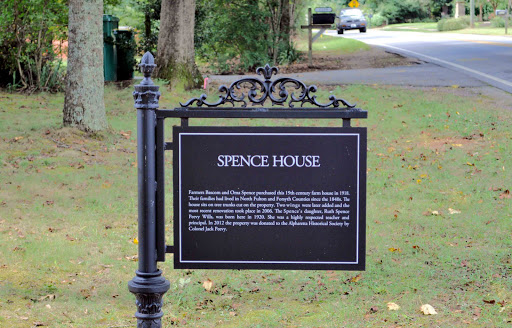
Farmers Bascom and Oma Spence purchased this 19th century farmhouse in 1918. Their families had lived in North Fulton and Forsyth Counties since the 1840s. The house sits on tree trunks cut on the...
- lat34
Crossroads of Destiny
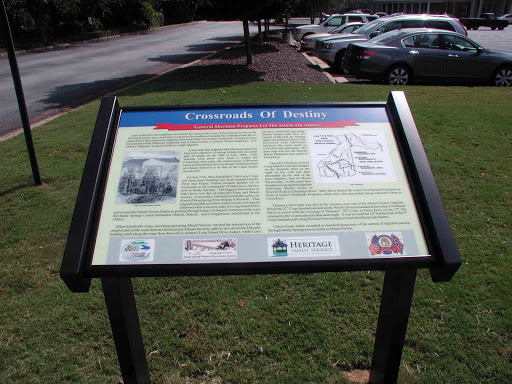
One of the first thoroughfares developed for opening this area of the land given out in the 1822 land lottery was a road from Lawrenceville southwest towards the Chattahoochee River,...
- lat34
Sandy Springs and the Civil War

The summer of 1864 brought changes to Sandy Springs that no one living at the time could have imagined. For a time, during the first weeks of July, 1864, the fields and farms of Sandy...
- lat34
David and Frances Cotting

This site was known as the Cotting Estate in the mid 1800’s. David Cotting, teacher, editor and lawyer, served as Secretary of State from 1868-1873. He was also a member of the constitutional...
- lat34
Fire Station No. 16 /Atlanta's First African-American Male ~ Female Firefighters

(side 1) During the civil rights movement, members of the African-American community pressured the Mayor and City Council of Atlanta to integrate the city's fire department. In 1962, Mayor Ivan...
- lat34
Tiger Flowers

Theodore “Tiger” Flowers was the first African- American boxer to win the world middleweight championship in 1926. Born in Camilla, Georgia in 1895. Flowers moved to Atlanta in 1920 when he began...
- lat34
Willis Pentecost Menefee - 1814 – June 24, 1855
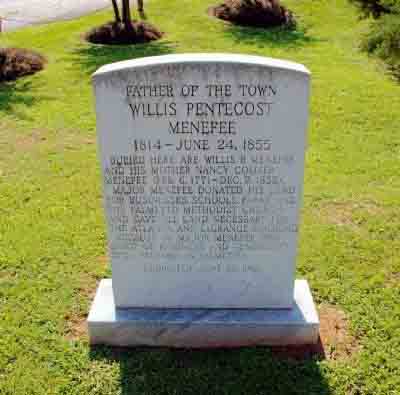
Willis Pentecost Menefee Father of the Town — 1814 – June 24, 1855 — Buried here are Willis P. Menefee and his mother Nancy Collier Menefee (Feb. 6, 1771 – Dec. 2, 1852). Major Menefee donated...
- lat34