
Royal Canadian Mounted Police 1873-1973

To bring law and order to the Canadian West, the North West Mounted Police was formed in 1873. Here, at the 'New Fort', was one of the first recruiting centres for the assembly and training of the...
- toronto
- ontario
- alan brown
Rosedale Villa

Near this site stood the home of Sheriff William Botsford Jarvis from 1826 to 1864. The original farmhouse of 1821 was enlarged and redesigned by John Howard in 1835 and stood until 1905....
- toronto
- ontario
- alan brown
The Queen's Rangers

The young province of Upper Canada (Ontario) required troops to defend it and to build public works essential to its development. The Queen's Rangers was the first regiment raised in...
- toronto
- ontario
- alan brown
Queen Mary Hospital

The first sanatorium in the world devoted exclusively to the treatment of children with tuberculosis, Queen Mary Hospital was opened in 1913. It formed part of a complex with the Toronto Hospital...
- toronto
- ontario
- alan brown
Queen Alexandra Gateway

Since 1962, the historic Queen Alexandra Gateway has served as a formal entrance to Philosopher's Walk, a meandering ravine which cuts through the northeastern grounds of the University of...
- toronto
- ontario
- alan brown
Queen Gardens

The Parkdale Village Business Improvement Area (PVBIA) encompasses the area along Toronto's celebrated Queen Street West from Dufferin Street to Roncesvalles Avenue. Because of its close proximity...
- toronto
- ontario
- alan brown
Queen's Park, Toronto

Officially opened by the Prince of Wales (later King Edward VII) during the Royal Tour of 1860, Queen's Park is an early example of the public park movement in Canada. Landscaped according to...
- toronto
- ontario
- alan brown
Queen's Park

In 1859 the city leased land here from King's College, and in 1860 a park, named after Queen Victoria, was opened by the Prince of Wales, later Edward VII. Queen's Park was long considered as...
- toronto
- ontario
- alan brown
Queen's Quay Terminal

NonePlaque via Alan L. Brown's site Toronto Plaques. Full page here.
- toronto
- ontario
- alan brown
Queen's Wharf Lighthouse

Now landlocked on Fleet Street, this lighthouse once stood on the Queen's Wharf. The wharf - originally known as New Pier - was built in 1833 to stimulate commercial activity in the west part of...
- toronto
- ontario
- alan brown
Queen Street Mental Health Centre

The first permanent mental health facility in Upper Canada, the Provincial Lunatic Asylum, forerunner of the present Centre, was officially opened on January 26, 1850. It was housed in what was...
- toronto
- ontario
- alan brown
Queen's Park

This park was opened September 11th, 1860, by the Prince of Wales, later King Edward VII and named in honour of his mother Queen Victoria.Plaque via Alan L. Brown's site Toronto Plaques. Full page here.
- toronto
- ontario
- alan brown
Queen Alexandra Gateway

This stone and wrought iron structure was a gift to the Imperial Order Daughters of the Empire to commemorate the visit, on October 10 and 11, 1901 of their Royal Highnesses, the Duke and Duchess...
- toronto
- ontario
- alan brown
Parsons Site

You are now near one of Toronto's most studied archeological sites. Around 1450, a large ancestral Huron-Wendat village stood on the rise of land overlooking Black Creek. Almost three hectares in...
- toronto
- ontario
- alan brown
Playter Farmhouse

This house was erected in the mid-1870's by John Lea Playter, a great grandson of United Empire Loyalist, Captain George Playter, who with his sons, was granted lands on both sides of the...
- toronto
- ontario
- alan brown
Primrose Club Building (Faculty Club) 1920

Architects Benjamin Brown and Arthur W. McConnell designed this building for the Primrose Club, an elite Jewish organization that provided its members with a private social space....
- toronto
- ontario
- alan brown
Paul Oberman Walk 1957-2011

Paul Oberman was a heritage preservationist, real estate developer and visionary city-builder who passionately believed and demonstrated that heritage buildings could be restored through adaptive...
- toronto
- ontario
- alan brown
Potter's Field of Muddy York

The Trustees of the Toronto General Burying Grounds established "The Potter's Field" on this site in 1826 as the area's first non-sectarian cemetery. This group of concerned citizens raised the...
- toronto
- ontario
- alan brown
Palais Royale

This building stands at the eastern end of the former Sunnyside Amusement Park. It was opened in 1922 as both a dance hall and Walter Dean's boat factory. Remodelled in 1924 and 1928, it...
- toronto
- ontario
- alan brown
Philosopher's Walk Amphitheatre
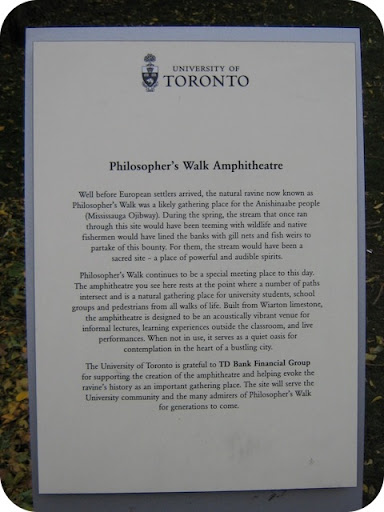
Well before European settlers arrived, the natural ravine now known as Philosopher's Walk was a likely gathering place for the Anishinaabe people (Mississauga Ojibway). During the spring,...
- toronto
- ontario
- alan brown