
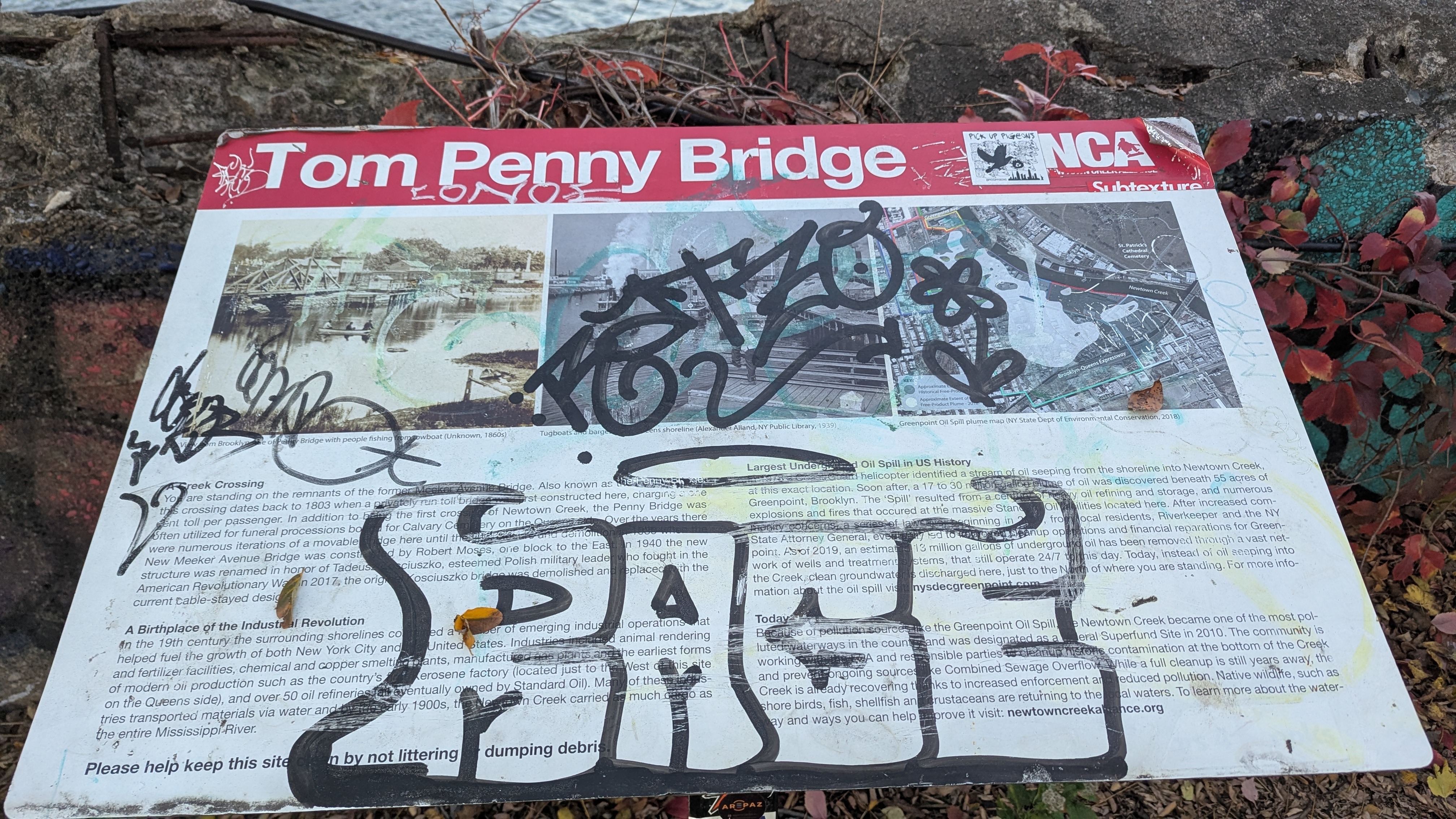
Tom Penny Bridge
A Creek Crossing
You are standing on the remnants of the former Meeker Avenue Bridge. Also known as the Penny Bridge,
this crossing dates back to 1803 when a privately run toll bridge was first constructed here, charging a one cent toll per passenger. In addition to being the first crossing of Newtown Creek, the Penny Bridge was often utilized for funeral processions bound for for Calvary Cemetery on the Queens side. Over the years there were numerous iterations of a movable bridge here until the final closure and demolition in 1930 when the New Meeker Avenue Bridge was constructed by Robert Moses, one block to the East. In 1940 the new structure was renamed in honor of Tadeus Kosciuszko, esteemed Polish military leader who fought in the American Revolutionary War. In 2017, the original Kosciuszko bridge was demolished and replaced with the current cable-stayed design.
A Birthplace of the Industrial Revolution
In the 19th century the surrounding shoreline contained a number of emerging industrial operations that United States. Industries included animal rendering and and fertilizer facilities, chemical and copper smelting plants, manufactured gas plants and the earliest forms of modern oil production such as the country's first kerosene factory (located just to the West of this site on the Queens side) and over 50 oil refineries (all eventually owned by Standard Oil). Many of these industries transported materials via water and by the early 1900s, the Newtown Creek carried as much cargo as the entire Mississippi River.
Largest Underground Oil Spill in US History
In 1978 a Coast Guard helicopter identified a stream of oil seeping from the shoreline into Newtown Creek, at this exact location. Soon after, a 17 to 30 million gallon plume of oil was discovered beneath 55 acres of Greenpoint, Brooklyn. The 'Spill' resulted from a century of heavy oil refining and storage, and numerous explosions and fires that occured at the massive Standard Oil facilities located here. After increased community concerns, a series of lawsuits beginning in 2004, from local residents, Riverkeeper and the NY State Attorney General, eventally led to improved cleanup operations and financial reparations for Greenpoint. As of 2019, an estimated 13 million gallons of underground oil has been removed through a vast network of wells and treatment systems, that still operate 24/7 to this day. Today, instead of oil seeping into the Creek, clean groundwater is discharged here, just to the North of where you are standing. For more information about the oil spill visit nysdecgreenpoint.com
Today
Because of pollution sources like the Greenpoint Oil Spill, the Newtown Creek became one of the most polluted waterways in the country and was designated as a federal Superfund Site in 2010. The community is working with the EPA and responsible parties to cleanup historic contamination at the bottom of the Creek and prevent ongoing sources ke Combined Sewage Overflow. While a full cleanup is still years away, the Creek is already recovering thanks to increased enforcement and reduced pollution. Native wildlife, such as shore birds, fish, shellfish ancrustaceans are returning to the local waters. To learn more about the waterway and ways you can help improve it visit: newtowncreekabance.org
Nearby Plaques
Loading…